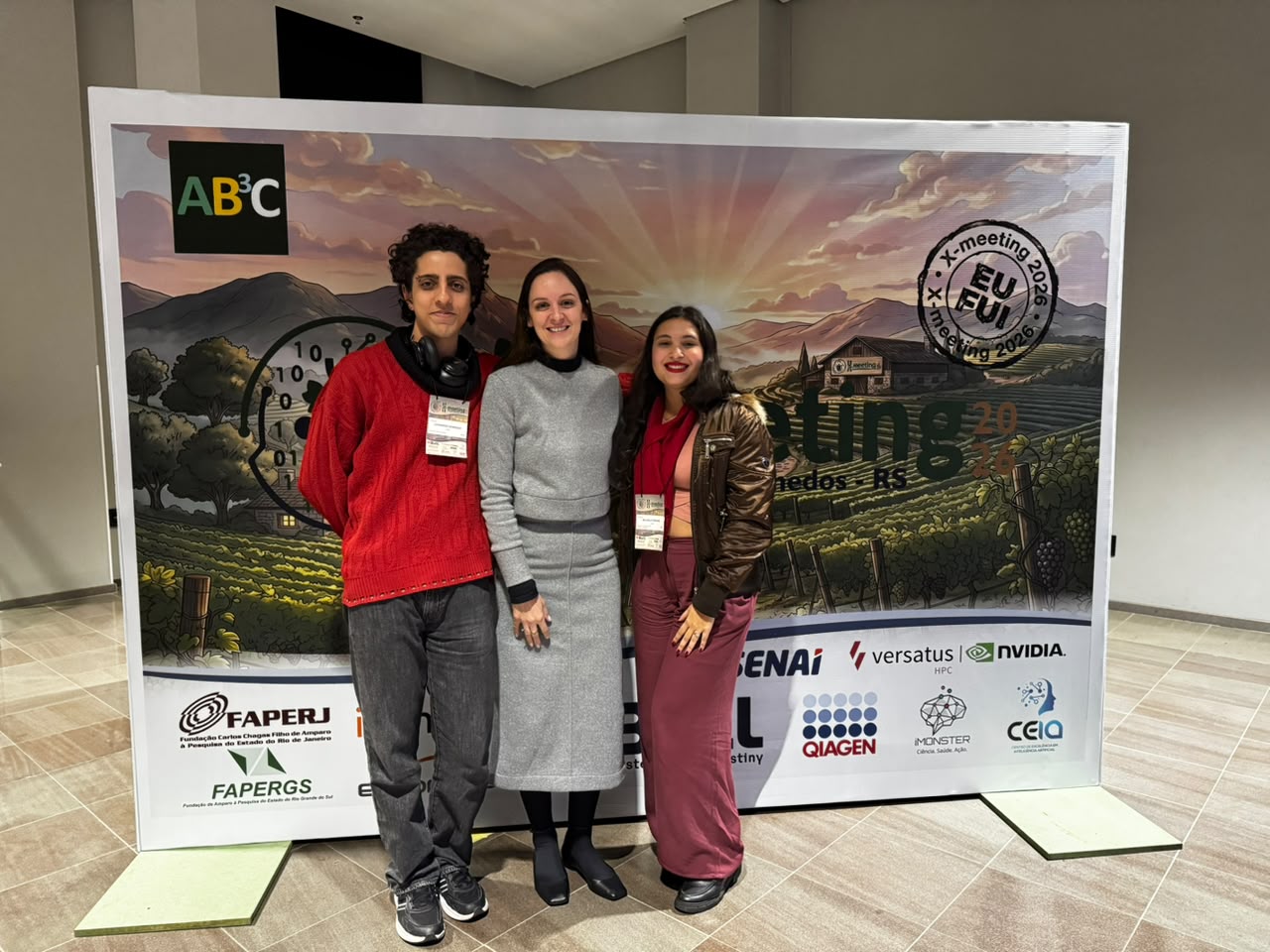
LBS participated in one of Brazil's leading bioinformatics events, strengthening scientific collaborations and showcasing research conducted by the laboratory.
From June 9 to 12, 2026, members of the Bioinformatics and Systems Laboratory (LBS) at the Federal University of Minas Gerais (UFMG) participated in X-Meeting 2026, held in the Vale dos Vinhedos region of Bento Gonçalves (RS). Considered one of Brazil's premier bioinformatics events, the gathering brought together researchers, students, and professionals to present research and discuss advancements in the field.
Prof. Dr. Raquel C. de Melo-Minardi, coordinator of the LBS, participated as a panelist in the roundtable discussion "Graduate Studies and Bioinformatics Education Networks," which brought together representatives from various graduate programs to discuss achievements and prospects for expanding integration among bioinformatics education and research networks in Brazil. The session fostered reflection on human resource development, the strengthening of institutional collaborations, and the challenges facing the field's growth.
Another highlight was the participation of PhD student Helena Lott, a finalist for the Young Bioinformatician Award, who secured second place. During the oral presentation of her project, "The Code of Life: A pilot project for applying bioinformatics in high school education," Helena presented the results of implementing an elective course that integrated molecular biology and programming using tools such as Scratch and Python. As an educational resource, she developed a free workbook containing interdisciplinary concepts and activities, aimed at supporting teachers interested in incorporating bioinformatics into the high school curriculum.
In the Late Poster category, master's student Leonardo Henrique da Silva presented the work "Towards a sequence-based machine learning approach for predicting antiviral peptides," which proposes a machine learning-based strategy for predicting antiviral peptides from their amino acid sequences. Utilizing various classification algorithms alongside structural and physicochemical descriptors, the developed model demonstrated consistent performance in identifying peptides with potential antiviral activity, highlighting how computational approaches accelerates the discovery of new therapeutic candidates.
Representing the laboratory in the poster category, PhD student Milenna M. Pirovani presented the study "Investigating the interaction between Matrixyl and TGF-β receptor I through molecular docking and molecular dynamics simulations." The research investigated the potential molecular mechanism of action of the dermocosmetic peptide Matrixyl using molecular docking and molecular dynamics simulations, evaluating its interaction with the TGF-βRI receptor.
In addition to the activities held during the conference, PhD candidate Milenna M. Pirovani and master's student João Vítor Fernandes Dias (from PPGCC) conducted the short course "Introduction to Using Biopython for Bioinformatics Data Analysis" as a pre-event activity organized by RSG-AB3C. The training covered fundamental concepts of the Biopython library, including biological sequence manipulation, access to public databases, protein analysis, and the construction of reproducible pipelines in Python.
LBS's participation in X-Meeting 2026 highlights the laboratory's commitment to excellence in research, teaching, and outreach, contributing not only to the development of new computational methodologies but also to the training of researchers and the dissemination of knowledge in bioinformatics.